Tuesday, March 19, 2013

"The Charge of the Light Brigade" by Alfred, Lord Tennyson

The Charge of the Light Brigade


Half a league, half a league,
Half a league onward,
All in the valley of Death
Rode the six hundred.
"Forward, the Light Brigade!
Charge for the guns!" he said:
Into the valley of Death
Rode the six hundred.

"Forward, the Light Brigade!"
Was there a man dismay'd?
Not tho' the soldier knew
Someone had blunder'd:
Theirs not to make reply,
There's not to reason why,
Theirs but to do and die:
Into the valley of Death
Rode the six hundred.

I was really excited to see this poem because it was one of my favorite's that I read back in high school. I recall reading it both in my literature and history class. This poem tells the story of the first military attack in the Crimean War, which was fought by the Russian Empire and the allied forces of France, Great Britain, Sardinia and the Ottoman Empire. I enjoy this poem because not only is history one of my favorite subjects, but because of it's flowing rhyme scheme. My favorite lines are, "Theirs not to make reply, there's not to reason why, there's but to do and die." It's a tragic story, yes, but most importantly it depicts the courage, dignity and fearlessness of the "noble six hundred." The soldiers didn't pose any questions or protest despite the fact that their commander had made a mistake; they rode onward anyway "into the valley of death", and very many were killed.

This poem has a dactylic rhythm - that is, each stressed syllable has two unstressed syllables right after it. Also, throughout the poem Tennyson repeats phrases and sometimes words, such as "Forward, the Light Brigade!" and "into the valley of Death." These repetitions give the poem more emphasis and a stronger tone. Below is a short clip I found from the movie "The Blind Side" that talks about the poem. :)




Sunday, February 24, 2013

"That time of year," by William Shakespeare

My attention was immediately captured after reading the first three lines of Shakespeare's sonnet, "That time of year thou mayst in me behold." It is a beautiful poem that I found myself reading more than a few times, not just to discover its true meaning but to allow each word to sink in. This sonnet is filled with metaphors that signify the speaker's awareness of his seniority and the loss of springtime (i.e. his youth.) It offers great imagery which really pulled me in and honestly displays the speaker's emotions. My favorite lines are the last two, which are:
 
“This thou perceiv’st, which makes thy love more strong,
To love that well which thou must leave ere long.”

I gathered the main theme of this poem is that life is short and our time while we are young is even more fleeting - we should enjoy this season while it lasts. This sonnet exemplifies the fear and distress one can experience when growing older; something I'm sure a lot of people can relate to.

Here is a funny comic that I found:

Monday, February 18, 2013

Response to Andrew Hudgins "Begotten"


Security, love
A true gift from above
Comfort, support
Something you can never sell short
Joy, laughter
A bothersome brother to chase after
Hardships, pain
Sometimes we lose, sometimes we gain
Near, far
It doesn’t matter where we are
Acceptance, care
Sometimes a thought, sometimes a prayer
White, brown
We’re still the same all around
Together, divorced
Love should never be forced
A meow, a bark
In my heart – a deep mark
Smiling faces, hugs that are free
That is what family means to me

Thursday, February 14, 2013

"We Grow Accustomed to the Dark" by Emily Dickinson

After listening to this poem in class the first thing that popped into my mind was the movie, Silver Linings Playbook. I saw it in theaters last Sunday and it really spoke to me, as did this poem. In the movie the main character, Pat, suffers from bipolar disorder and is finally released from a psychiatric hospital after eight months. He returns to his family fully determined to turn his life back around. I don't want to say too much for fear of spoiling the movie for those who haven't seen it, but the main point of the movie is Pat searching for his "silver lining" after many miles of stumbling in the dark.

Emily Dickinson's "We Grow Accustomed to the Dark" is similar to Silver Linings Playbook because I feel that both depict the struggles and uncertainty we face in life and how we can eventually overcome them. "You have to do everything you can. You have to work your hardest. If you do that, if you stay positive, you have a shot at a silver lining." This is what came to mind after listening and reading this deep, meaningful poem.


Wednesday, January 30, 2013

"A Very Old Man with Enormous Wings"


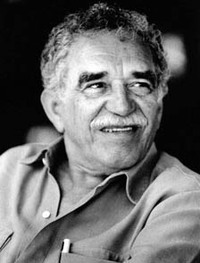
Marquez gave us a very intriguing story about an angel (AKA the "very old man") and his enormous wings, expressing to his readers the complex nature of humans. Marquez offered his readers a great representation of how people normally react towards things that are strange and unfamiliar. One example would be in the beginning of the story when Pelayo and his wife, Elisenda, decide to put the angel on a raft in the ocean and provide him with provisions with the mere intention of getting rid of him. However, when they learn that they could get money for showing him off to their neighbors they decide to take him back to their chicken coop. 

Another example would be one of compassion and benevolence given by the angel. Instead of leaving their household when the people came to visit him, some harassing him with stones so that he would move, the angel remained there and helped the family become rich. When the angel finally leaves the house, rising to the sky after a few attempts before disappearing off into the distance, Elisenda is said to feel relief. Why does she feel relieved? My understanding is that once the angel left, her life with her family had returned to normal and this gave her a firm sense of security and freedom. The last line is one of my favorite's in the story:

 "She kept watching him even when she was through cutting the onions and she kept on watching until it was no longer possible for her to see him, because then he was no longer an annoyance in her life but an imaginary dot on the horizon of the sea."


Wednesday, January 23, 2013

Sonny's Blues by James Baldwin


It didn't take me very long to get into James Baldwin's "Sonny's Blues", in fact I think I was hooked after reading the very first paragraph. There was just something about Baldwin's style that really drew me in and captivated me. From beginning to end I marked several quotes that honestly struck me and got me thinking. Below are a couple I wanted to share.

 "All of this was carrying me some place I didn't want to go. I certainly didn't want to know how it felt; it filled everything, the people, the houses, the music, the dark, quicksilver barmaid, with menace; and this menace was their reality." 

 This quote made me think of suffering and how, throughout the story, the narrator detects it wherever he goes. Suffering is definitely a major theme here because the narrator reveals it when he gives us flashbacks of his past (e.g. his mom telling the story of the death of his father's brother), and in telling us readers about the present. While it was obvious that Sonny suffered quite a bit I felt more sympathy towards the narrator because he knew his brother was in pain yet he had no idea what to do about it. Which raises the question: is there anything one can do about it? Near the end of the story the narrator asks, "But there's no way not to suffer - is there, Sonny?"

 "Yet, when he smiled, when we shook hands, the baby brother I'd never known looked out from the depths of his private life, like an animal waiting to be coaxed into the light."

I really liked the visual imagery in this sentence, let alone throughout the entire story. That was one of the main reasons why I enjoyed Baldwin’s writing – his words were incredibly descriptive and engaging; I never lost interest. Overall I think the story was not only very well-written but it offered the readers a great message: the true importance of family and the healing power of music.


Ray Charles was a great Blues musician and "Georgia on my Mind" is my favorite song of his. :)